
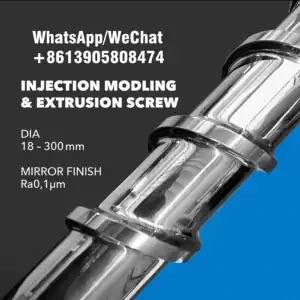

In the plastics and compounding industries, wear, corrosion and dimensional stability of screw and barrel components are constant challenges. One of the proven solutions is the bimetallic screw barrel—a dual-metal configuration where a wear-resistant alloy is bonded to a structural steel core. In this post, we explain what bimetallic screw barrels are, their advantages, design considerations, and performance evidence from industry sources.
What Is a Bimetallic Screw Barrel?
A bimetallic screw barrel consists of two layers: a base or structural steel (e.g. 4140 or similar) plus an internal lining or overlay of a harder alloy (often containing chromium, nickel, or carbides). The liner thickness typically ranges from 1 mm to 2 mm. deermachine.com+3santafemachine.com+3jinzeplastic.com+3
This metallurgical bond is often achieved via centrifugal casting, thermal spray, or alloy cladding processes. The inner alloy adds abrasion and corrosion resistance, while the steel core provides toughness and structural integrity. santafemachine.com+2jinzeplastic.com+2
Compared to a monolithic nitrided barrel, the bimetallic version offers greatly enhanced wear life for demanding materials. According to Jinze, a bimetallic screw barrel can deliver 3–7× higher abrasion resistance than standard nitrided barrels, depending on alloy grade. jinzeplastic.com
Why Use Bimetallic Screw Barrels? Key Benefits
1. Longer Service Life for Abrasive & Filled Polymers
Filled materials (e.g. glass fiber, calcium carbonate, mineral fillers) tend to abrade metal surfaces. Industry reports suggest that aggressive fillers may reduce screw/barrel life by up to 50 % or more if not properly protected. ptonline.com
By contrast, a well-selected bimetallic liner preserves geometry longer, slows wear, and reduces replacement frequency. Deer Machine notes that in abrasive or corrosive environments, bimetallic barrels can last several years, outperforming conventional barrels by 3–5× in many cases. deermachine.com
2. Better Corrosion & Chemical Resistance
When processing corrosive polymers (e.g. PVC, fluoropolymers, or materials that emit acids), standard steels suffer chemical attack. A nickel-alloy liner or chromium-nickel overlay combats corrosive wear and helps maintain smooth internal surfaces. haisiextrusion.com+2santafemachine.com+2
3. Stable Processing & Consistency
Because the bimetallic liner resists dimensional loss, the clearance between screw and barrel remains more stable. That steadiness helps maintain melt flow, minimizes backflow or leakage, and delivers consistent quality and throughput. deermachine.com+2haisiextrusion.com+2
4. Reduced Downtime & Lower Total Cost
While a bimetallic component has a higher upfront cost than a simple nitrided barrel, its longer life and fewer replacements (plus lower scrap risk) translate into lower lifecycle cost. Many manufacturers find that the investment pays off via reduced downtime, fewer rebuilds, and more consistent output.
Design & Material Considerations
To make a good bimetallic screw barrel, several factors must be considered:
- Choice of alloy: The inner liner may be a chromium-nickel alloy, iron-based wear alloy, nickel-based overlay with carbides, or tungsten-carbide enriched surfaces, depending on whether abrasion or corrosion is dominant. santafemachine.com+2deermachine.com+2
- Liner thickness & bonding quality: Too thin a layer loses wear life; too thick may crack or delaminate under stress. Bond strength is critical.
- Thermal expansion match: The coefficient of thermal expansion (CTE) between core steel, liner, and screw should be compatible to reduce differential strain and avoid seizing. Haisi’s analysis warns about seizing caused by mismatched expansion under high-temperature resins. haisiextrusion.com
- Clearance & gap control: The gap between screw and barrel is typically on the order of 1/1000 of the diameter. Precise machining and periodic inspection are needed to keep that clearance under control. haisiextrusion.com+1
- Repairability: Good suppliers enable refurbishment of the liner or rebuilding after wear instead of full replacement.
Use Cases & Brand Examples
Several well-known companies provide bimetallic screw/barrel products:
- Xaloy is a leading brand in extrusion front-end components; they offer a wide range of bimetallic screws and barrels tailored for high wear/corrosion applications. xaloy.com
- DRTS (pipe-extrusion supplier) promotes extruders with bimetallic screws & barrels, arguing that they enable the processing of recycled or off-spec plastics while protecting machine life. drts.com
- OEMs of extruders often equip the high-wear zones (e.g. downstream mixer, metering zone) with bimetallic components as standard or optional upgrades.
In tough service areas like pipe extrusion using recycled blends or high-filler formulations, a bimetallic screw barrel often becomes a baseline requirement to maintain uptime and consistency.
Market & Industry Trends (Data Snapshot)
- The broader feed screw barrel market (including extrusion and related domains) was valued at USD 1.43 billion in 2024, with projected CAGR of 5.6 % through 2034. Global Market Insights Inc.
- The bimetallic screw barrel segment is a noticeable high-margin niche, especially for applications in compounding, high-performance polymers, and abrasive filled resins. (Some market analysis sources estimate the bimetallic part of the segment is worth around USD 150 million in 2024, growing to ~USD 250 million by 2033 at ~6.2 % CAGR) 领英
These figures indicate strong and growing demand for robust extrusion components as polymer blends, recycled plastics, and filled compounds become more common.
Tips for Implementing Bimetallic Screw Barrels
- Match liner alloy to your material (abrasion-dominant vs. corrosion-dominant).
- Work with reputable suppliers that guarantee bonding integrity, material quality and refurbishment service.
- Monitor wear and clearance regularly, and refurbish before damage escalates.
- Test under real production conditions to validate performance gains (e.g. throughput retention, energy consumption, scrap rate).
- Include performance warranties or life guarantees if possible—good vendors often provide them.
If you’d like a customized recommendation (liner alloy, thickness, geometry) for your polymer, throughput or wear regime, feel free to contact me:
Elena (Sales Manager)
Zhoushan Juyuan Machinery Co., Ltd.
Website: https://juyuan-machinery.com/
Email: cxj.job@gmail.com
WhatsApp / Phone: +86 13905808474