

Extruder screw and barrel wear is one of the most common causes of declining performance in plastic extrusion lines.
A machine may continue running, but operators gradually notice lower output, unstable pressure, higher screw RPM or inconsistent melt quality. Because this deterioration often develops slowly, the screw and barrel may not immediately be suspected.
In many cases, the real problem is increasing clearance between the screw flights and the barrel bore.
Knowing the early warning signs can help processors schedule maintenance before production efficiency deteriorates further.
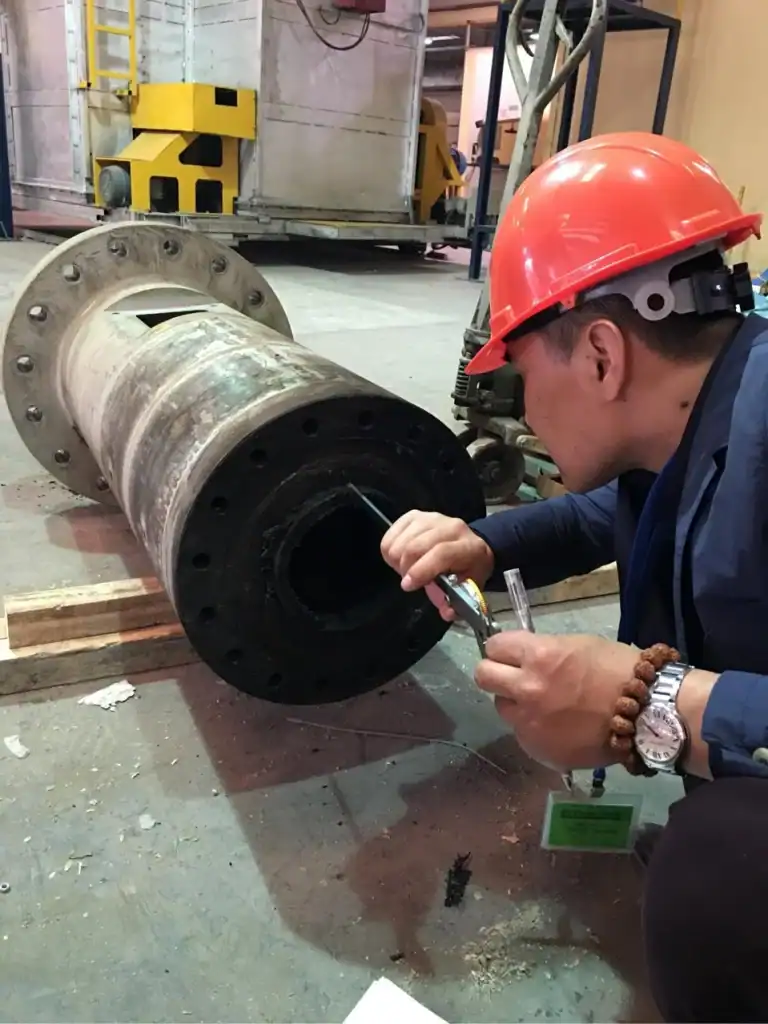
Why Do Extruder Screws and Barrels Wear?
During extrusion, the screw rotates continuously inside the barrel while conveying, melting and pressurizing polymer.
Both components operate under temperature, pressure, friction and mechanical load.
Wear becomes more severe when processing abrasive materials such as:
- Glass-fiber-reinforced plastics
- High CaCO3 filler compounds
- Recycled plastics containing contamination
- Mineral-filled polymers
- Certain engineering plastics
- Highly abrasive masterbatch formulations
Corrosive polymers or additives can create an additional challenge.
For standard applications, nitrided 38CrMoAlA screw barrels can provide good performance. For strongly abrasive applications, a bimetallic screw and barrel or other wear-resistant alloy treatment may provide longer service life.
1. Extruder Output Gradually Decreases
One of the clearest symptoms of screw and barrel wear is declining production capacity.
For example, an extrusion line that previously produced 300 kg/h under normal conditions may gradually fall to 260 or 240 kg/h.
Operators sometimes compensate by increasing screw RPM.
This may temporarily improve production, but it does not solve excessive screw-to-barrel clearance.
As clearance increases, more molten polymer can flow backward across the screw flights instead of being pumped efficiently toward the die.
The result is reduced pumping efficiency and lower stable output.
2. Screw RPM Must Increase to Maintain the Same Output
Compare current operating data with the machine’s historical production records.
If the machine previously achieved the required output at 60 RPM but now requires 75 RPM under similar conditions, screw and barrel wear should be investigated.
However, RPM alone cannot diagnose wear.
Also check:
- Raw material
- Feed condition
- Temperature settings
- Screen pack
- Die resistance
- Motor load
- Melt pressure
If these conditions remain similar but RPM continues increasing, measuring the screw and barrel becomes important.
3. Melt Pressure Becomes Unstable
Stable extrusion requires consistent material delivery to the die.
Worn screw flights and excessive barrel clearance can reduce the screw’s ability to develop and maintain pressure.
Operators may notice fluctuating melt pressure or difficulty reaching the normal operating pressure.
This can eventually affect product dimensions and production stability.
Dynisco notes that successful extrusion depends on maintaining stable output and melt quality at a controlled rate, making pressure an important process variable to monitor.
4. Product Quality Becomes Inconsistent
Screw wear is not only an output problem.
It can also affect melting and mixing.
Depending on the application, processors may experience:
- Uneven melt temperature
- Poor color dispersion
- Unmelted particles
- Dimensional instability
- Surface defects
- Inconsistent extrusion
Before assuming the screw is responsible, other process conditions should also be checked.
But when quality problems appear together with declining output and unstable pressure, mechanical wear becomes a stronger possibility.
5. Screw-to-Barrel Clearance Has Increased
This is one of the most useful measurements for evaluating screw barrel condition.
A new screw and barrel are manufactured with a controlled clearance between the screw flight OD and barrel ID.
After long-term operation, the screw OD can become smaller while the barrel ID becomes larger.
The resulting clearance gradually increases.
Dynisco’s technical handbook specifically notes that screw/barrel clearance can increase over operating time and that abrasive fillers such as glass can create serious wear problems.
This is why actual measurement is more reliable than judging condition only from operating hours.
6. Visible Wear Appears on the Screw
When the screw is removed during maintenance, inspect the complete working surface.
Look for:
- Reduced flight diameter
- Rounded flight edges
- Scratches
- Grooves
- Pitting
- Corrosion
- Damaged coating
- Uneven wear
Pay particular attention to areas where pressure and melting loads are high.
Do not measure only one position.
We recommend measuring the screw OD at several points along the working length and comparing these measurements with the original drawing or specification.
7. The Barrel ID Is Worn or Out of Tolerance
The barrel must also be inspected.
Replacing only the screw while continuing to use a severely worn barrel may not restore the required operating clearance.
Measure the barrel internal diameter at multiple positions.
The actual measurements can then be compared with:
Original barrel ID + current screw OD + required operating clearance
This helps determine whether the screw, barrel or both components should be replaced.
Repair the Screw or Replace the Complete Screw Barrel?
The correct decision depends on the extent and location of wear.
Minor screw wear may sometimes be repairable by rebuilding the flight surface and machining it back to the required dimensions.
However, repair is not always the most economical solution.
For severely worn components, replacing the screw and barrel as a matched set can provide better dimensional control and more predictable performance.
Before manufacturing a replacement, we normally request:
- Machine model
- Screw diameter
- Screw working length
- L/D ratio
- Plastic material
- Current output
- Required output
- Screw RPM
- Motor power
- Original drawing, if available
- Photos of the old screw and barrel
For custom or older extrusion machines without drawings, detailed measurements can also be used for reverse engineering.
How Can Screw and Barrel Service Life Be Improved?
The first step is selecting materials according to the polymer application.
A standard nitrided screw barrel may be suitable for normal PE or PP processing, while abrasive compounds may require a more wear-resistant solution.
Processors should also avoid unnecessary mechanical and thermal stress.
Correct temperature settings, suitable screw speed, stable feeding and proper maintenance all contribute to service life.
Regularly recording output, RPM, motor current, melt temperature and pressure also creates a useful performance history.
When production begins deteriorating, these records make troubleshooting much easier.
Nitrided or Bimetallic Screw Barrel?
There is no single material solution for every extruder.
For relatively non-abrasive polymers, a nitrided 38CrMoAlA screw barrel can offer a good balance between performance and cost.
For applications involving glass fiber, high mineral loading or strongly abrasive recycled materials, bimetallic protection may provide better wear resistance.
Dynisco’s extrusion handbook also discusses nitriding and bimetallic barrel construction as methods for improving wear and corrosion resistance.
The correct choice should therefore be based on the material being processed rather than price alone.
Need to Replace a Worn Extruder Screw and Barrel?
If your extruder has lost output or you suspect excessive screw and barrel clearance, send us:
machine model + plastic material + screw diameter + working length + photos or drawing.
Zhoushan Juyuan Plastic Machinery Co., Ltd. can manufacture replacement extruder screws and barrels according to drawings, samples or measured dimensions.
For abrasive applications, we can also evaluate nitrided and bimetallic material options according to your polymer and filler content.