
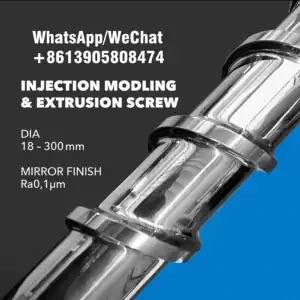
How Compression Ratio, Pitch & Channel Depth Impact Extrusion Performance — A Must-Read for Process Engineers
In extrusion, success lies in the details of screw geometry.
Three key parameters determine how well your extruder handles plastic melting, mixing, pressure building, and output:
- Compression Ratio (CR)
- Screw Pitch
- Channel Depth (a.k.a. flight depth or groove depth)
This guide breaks down how each of these affects your output rate, melt quality, energy consumption, and product stability — and how to choose the right configuration for your material and application.
1️⃣ Compression Ratio (CR)
Definition:
The ratio between the channel depth in the feed zone and the channel depth in the metering zone.
Typical Values:
- Low CR: 1.2 – 1.6
- Medium CR: 1.7 – 2.4
- High CR: 2.5 – 3.5
🔧 High Compression Ratio (>2.5)
- Strong pressure buildup
- High shear → improves mixing
- Reduces voids and bubbles
- Used for rigid PVC, WPC, filled compounds
⚠️ Risk: Overheating or degradation of heat-sensitive polymers
🔧 Low Compression Ratio (<1.6)
- Gentle melting, low shear
- Better for LDPE, EVA, PLA, foamed products
Best For: Heat-sensitive, high-slip or low-viscosity polymers
🧠 Juyuan Insight:
If your product has surface defects or burn marks, reducing CR can reduce shear and improve melt stability.
2️⃣ Screw Pitch (Lead Distance)
Definition:
The axial distance between two adjacent flights on the same helix.
Impact:
- Controls residence time
- Affects conveying rate and pressure gradient
- Influences shear stress and output stability
🔧 Long Pitch
- Faster conveying
- Less residence time
- Used for high-throughput, low-viscosity materials
Risk: Poor melting or incomplete homogenization
🔧 Short Pitch
- Longer residence time → better melting
- Creates higher pressure buildup
- Used for crystalline materials, recycled plastics, PET, PVC
📌 Juyuan Tip: A variable pitch (gradually decreasing from feed to metering) is often used in barrier screws to balance throughput and melting efficiency.
3️⃣ Channel (Flight) Depth
Definition:
The radial depth between the screw root and the barrel inner surface.
Impact:
- Controls material volume per turn
- Affects melt pool size, shear rate, and energy input
🔧 Deep Channel
- High volume throughput
- Less pressure build-up
- Best for bulk conveyance in feed zone
🔧 Shallow Channel
- Stronger pressure
- Improved melt sealing and homogenization
- Common in metering zone
Channel Depth Design by Zone:
| Zone | Channel Depth | Function |
|---|---|---|
| Feed Zone | Deep | Solid transport |
| Compression Zone | Tapering | Melting and pressurization |
| Metering Zone | Shallow | Final melt delivery |
⚠️ Watch Out: Too shallow a channel in the metering zone may cause back pressure, increased torque, and overheating.
🎯 Putting It All Together: Design Example
Material: WPC (Wood Plastic Composite)
Recommended:
- CR: 2.8–3.2
- Pitch: short in metering zone
- Channel: deep feed, shallow metering
Goal: High-pressure melting with strong mixing for abrasive filler-loaded material.
Material: PLA Film
Recommended:
- CR: 1.4–1.6
- Pitch: long and constant
- Channel: medium depth
Goal: Gentle melting, avoid degradation
🔬 Modern Trends in Screw Geometry
- Variable pitch + variable depth: Tailored melting curves
- Barrier screws: Two-channel design for precise melt control
- Mixing sections (Maddock, Spiral): Improved melt quality without over-shear
- CFD design simulation: Predicts melt pressure, temperature, shear zones
At Zhoushan Juyuan Machinery, we use these techniques to design screws optimized for your polymer, throughput, and machine brand.
📞 Need Help Choosing the Right Screw Design?
Whether you’re processing PVC pipe, PET sheet, WPC profile, or PLA film — the right combination of compression ratio, pitch, and channel depth makes all the difference.
Zhoushan Juyuan Machinery Co., Ltd.
📧 Email: cxj.job@gmail.com
📱 WhatsApp: +86 13905808474
🌐 Website: https://juyuan-machinery.com
Send us your material and product specs — we’ll design a screw that maximizes performance and longevity.