
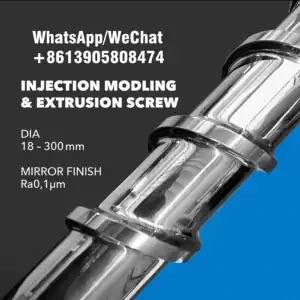
The material selection for conical twin-screw barrels plays a decisive role in determining the extrusion equipment’s wear resistance, corrosion protection, and overall service life. As extrusion processes become more demanding—handling highly filled polymers, abrasive additives, and corrosive compounds—innovative materials have emerged to meet these challenges.
This article introduces the latest materials revolutionizing conical twin-screw barrel manufacturing.
🛠️ 1. Advanced Alloy Steels
- 38CrMoAlA and 42CrMo Alloys:
Widely used due to their excellent mechanical strength and hardenability, these alloy steels provide a strong base for barrel construction. - Nitrided Steel:
Surface nitriding enhances hardness and wear resistance without compromising toughness, extending barrel life in abrasive environments.
🛡️ 2. Bimetallic and Multi-Layer Composite Materials
- Bimetallic Barrels:
Consist of a wear-resistant inner liner (Fe-based or Ni-based alloy) metallurgically bonded to a structural steel jacket.- Offers significant improvement in abrasion and corrosion resistance.
- Suitable for high filler-content PVC, WPC, and abrasive compounds.
- Tri-metallic and Composite Liners:
Newer designs incorporate additional layers or composite materials to balance wear resistance and toughness further.
🔥 3. Wear-Resistant Coatings
- Colmonoy and PTA (Plasma Transferred Arc) Hardfacing:
Applied on barrel inner surfaces and screw flights to provide a hard, corrosion-resistant layer.- Protects against abrasive fillers like CaCO₃ and glass fibers.
- Reduces friction, improving energy efficiency.
- Ceramic and Carbide-Based Coatings:
Experimental use of ultra-hard coatings enhances surface durability, especially for highly abrasive materials.
🌐 4. Corrosion-Resistant Materials
- For processing corrosive polymers (e.g., PVC with acidic stabilizers), materials with enhanced corrosion resistance are essential.
- Stainless Steel Liners and Coatings:
Used selectively in barrel sections exposed to chemical attack, balancing corrosion protection and wear resistance.
🔬 5. Emerging Nanomaterials and Composites
- Incorporation of nano-structured alloys and composite coatings promises to elevate barrel life and performance.
- Nanomaterials improve hardness, thermal stability, and reduce friction beyond traditional alloys.
📈 Benefits of Using Advanced Materials
| Material Type | Key Advantages | Typical Applications |
|---|---|---|
| Alloy Steels | High strength and toughness | General extrusion barrels |
| Bimetallic Liners | Superior wear and abrasion resistance | PVC/WPC with fillers, abrasive compounds |
| Hardfacing Coatings | Enhanced surface hardness | High abrasion and corrosion environments |
| Corrosion-Resistant Alloys | Chemical resistance | Corrosive polymer processing |
| Nanocomposites | Improved durability and thermal stability | Next-gen barrels, research stage |
📞 Choose Zhoushan Juyuan for High-Quality Barrel Materials
We utilize the latest materials and coating technologies to manufacture durable, high-performance conical twin-screw barrels tailored to your extrusion needs.
📧 Email: cxj.job@gmail.com
🌐 Website: https://juyuan-machinery.com/
📱 WhatsApp: +85244499051