
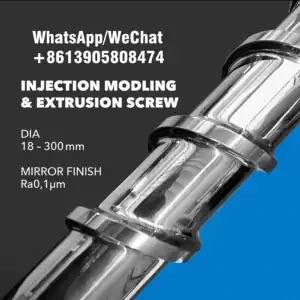
In extrusion and injection molding production, profit is not only about sales price—it is about cost per ton. Many manufacturers face the same headache:
- The machine runs too slow
- Power consumption is too high
- Output cannot increase
- Electricity and labor cost keep eating the profit
If you feel your line is “working hard but producing less,” the real issue is often not the motor power or operator skill. In most cases, it comes from inefficient plasticizing, worn screw & barrel, and an unoptimized screw design.
Let’s look at the main reasons and proven solutions.
Why Your Machine Runs Slow and Consumes Too Much Energy
1) Poor melting efficiency = more energy, less output
If the screw cannot melt the material efficiently, the machine must run longer time to reach stable production. This causes:
- Higher barrel heating energy
- Higher motor load
- Lower output per hour
- Higher energy cost per kilogram
A good screw design should balance:
- Solid conveying
- Melting speed
- Mixing uniformity
- Stable metering
External link: Understanding energy use in plastic processing
https://www.energy.gov/eere/amo/advanced-manufacturing-office
2) Worn screw & barrel reduces pumping efficiency
When the barrel inner diameter becomes worn, or screw flights become thinner, the clearance increases. This leads to:
- Melt leakage and backflow
- Reduced pressure build-up
- Low output even at higher RPM
- Higher energy consumption without real production gain
Many factories increase RPM to chase output, but worn parts only make the motor work harder and the temperature rise faster—without improving throughput.
Internal link (product): High Precision Screw & Barrel
https://juyuan-machinery.com/screw-barrel/
3) Wrong screw structure for your material and target output
Different materials need different screw geometry. For example:
- PP/PE high-speed extrusion requires strong melting and stable output
- PVC formulations need controlled shear and stable temperature
- Recycled materials require better mixing and venting options
- High filler compounds require wear-resistant design and smooth flow
If the screw design is not suitable, the result is usually:
- Slow running speed
- High melt temperature
- Unstable output
- Higher scrap rate
Internal link (service): Custom Screw Design & Manufacturing
https://juyuan-machinery.com/custom-screw-barrel/
4) Die head resistance or melt flow restriction
Sometimes the bottleneck is not the screw—it is the die head. If the die head flow channel is not optimized, it can create:
- High pressure load
- Low output
- Higher motor consumption
- Difficult start-up and unstable operation
Internal link (product): Extrusion Die Head & Components
https://juyuan-machinery.com/extrusion-die-head/
The Real Profit Killer: Cost per Ton Keeps Rising
Low output and high energy consumption usually lead to:
- More labor hours per ton
- Higher electricity bill per ton
- Longer production cycle
- Higher machine wear and maintenance frequency
Even if your product price stays the same, your profit margin will drop quickly.
That’s why improving throughput is not only about “speed”—it’s about efficiency and stability.
Proven Solutions to Increase Output and Reduce Energy Consumption
1) Upgrade to a high-efficiency screw design
A high-efficiency screw can improve plasticizing and reduce energy waste. Benefits include:
- Faster melting
- Lower motor load
- Stable pressure and output
- Better mixing quality
- Higher output per hour
For many extrusion lines, upgrading screw design can be one of the fastest ways to improve performance without changing the whole machine.
2) Use wear-resistant solutions for long-term stable output
If you process abrasive materials (CaCO₃, glass fiber, mineral fillers, recycled plastics), wear happens faster and output drops over time.
A bimetallic barrel can help maintain stable clearance and efficiency for longer service life.
Internal link (product): Bimetallic Screw Barrel
https://juyuan-machinery.com/bimetallic-screw-barrel/
3) Reduce downtime and stabilize production
Slow production is often combined with:
- frequent adjustments
- unstable melt pressure
- frequent cleaning
- screen changes
- unplanned shutdowns
A stable screw & barrel system helps you run longer with fewer stops, which directly reduces labor cost and increases daily output.
4) Match screw, barrel, and die head as one system
Many factories upgrade only one part, but the best result comes when the whole system is optimized together:
- Screw design for your material
- Correct barrel wear resistance level
- Smooth die head flow channels
- Proper heating and temperature profile
When the system is matched correctly, you get:
✅ higher output
✅ lower kWh per kg
✅ better product quality
✅ lower cost per ton
How We Help Customers Improve Output and Reduce Energy Cost
At Zhoushan Juyuan Machinery Co., Ltd, we support extrusion and injection molding manufacturers with:
- High precision screw & barrel manufacturing
- Wear-resistant bimetallic solutions
- Customized screw design based on your material and output target
- Technical support to reduce energy consumption and improve productivity
To recommend the best solution, please share:
- Screw diameter and L/D
- Material type (PP/PE/PVC/recycle, etc.)
- Filler ratio (%)
- Current output (kg/h) and RPM
- Machine brand/model and product type
Contact Us (Fast Reply)
Chen Xiujiang
Zhoushan Juyuan Machinery Co., Ltd
🌐 Website: https://juyuan-machinery.com/
📧 Email: cxj.job@gmail.com
📱 Phone/WhatsApp/WeChat: +86 13905808474
If your machine is running slow, consuming too much electricity, and output cannot increase, contact us today. We will help you improve efficiency, increase throughput, and reduce cost per ton.