
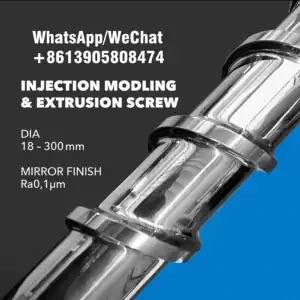
In plastic extrusion and injection molding, the gap between screw and barrel—also called clearance—is one of the most important technical parameters. It determines the extrusion quality, plasticizing efficiency, and the service life of the screw and barrel. A correct clearance ensures smooth operation and consistent product quality, while an improper gap can lead to serious wear, overheating, or poor melting performance.
🔍 What Is the Gap Between Screw and Barrel?
The gap refers to the distance between the outer diameter of the screw flights and the inner wall of the barrel.
During operation, the screw rotates inside the barrel, conveying and melting plastic. This small clearance allows the screw to move freely without excessive friction while maintaining sufficient pressure to push the molten material forward.
⚙️ Why the Gap Matters
- Plasticizing Efficiency
Proper clearance ensures effective shearing and melting of the plastic. Too wide a gap reduces shear heat and causes incomplete melting. - Backflow Control
If the gap is too large, molten polymer will flow backward, reducing output and pressure stability. - Wear Resistance
A gap that’s too small increases friction and wear on both screw and barrel, shortening their service life. - Energy Consumption
The right clearance reduces mechanical resistance and energy loss, improving machine efficiency. - Product Quality
Uniform melting and stable pressure lead to consistent product dimensions and surface finish.
📏 Recommended Gap Sizes
The ideal gap depends on the screw diameter and processing material, but here are general guidelines:
| Screw Diameter (mm) | Recommended Gap (mm) |
|---|---|
| 20–45 | 0.05–0.10 |
| 45–80 | 0.10–0.15 |
| 80–150 | 0.15–0.20 |
| 150+ | 0.20–0.25 |
For precision extrusion (such as medical tubing or micro profiles), the clearance should be at the lower end of the range.
🧠 How Wear Affects the Gap
During long-term operation, friction between the molten polymer and metal surface gradually increases the clearance.
Once the gap grows beyond the tolerance range:
- Output can drop by 5–10% or more.
- Melt temperature and quality become inconsistent.
- Energy consumption increases.
Regular inspection and maintenance are therefore essential to maintain efficiency.
🛠 How to Measure and Maintain the Gap
- Measure Barrel ID and Screw OD
Use bore gauges or micrometers to check the barrel’s internal diameter and the screw’s outer diameter at several points. - Monitor Output Changes
If extrusion output drops significantly or motor load changes, check for wear. - Use Surface Hardening Treatments
Choose nitrided or bimetallic barrels and hardened screws to reduce wear and extend service life. - Regular Maintenance
Clean the screw and barrel regularly and replace components when the clearance exceeds design limits.
🔧 Materials and Surface Treatments
For long-lasting performance, use high-strength materials with specialized coatings:
- Screw Materials: 38CrMoAlA, SACM645, SKD61
- Barrel Materials: 38CrMoAlA, bimetallic alloy
- Surface Treatments: Gas nitriding, hard chrome plating, or bimetallic alloy lining
These combinations help maintain a stable clearance even under high temperatures and abrasive processing conditions.
🔗 Related Product
To reduce wear and maintain an optimal gap, explore our Bimetallic Screw and Barrel — engineered for high precision, long service life, and excellent resistance to abrasion and corrosion.
📩 Contact Us
Need technical support or custom manufacturing for your extruder screw and barrel?
We can help you calculate the correct clearance and design suitable solutions for your production line.
Zhoushan Juyuan Machinery Co., Ltd.
📧 Email: cxj.job@gmail.com
📞 WhatsApp/WeChat: +86 13905808474
🌐 Website: https://juyuan-machinery.com