
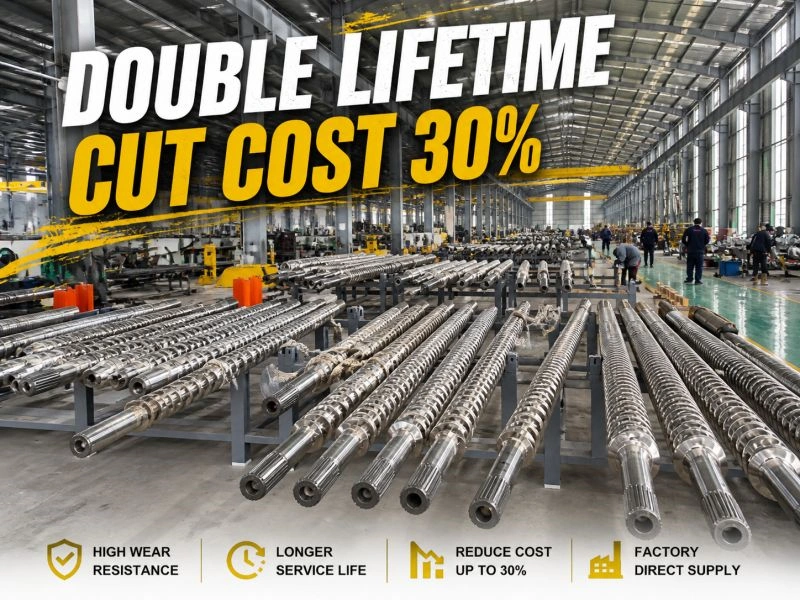
The extruder screw and barrel is one of the most important components of a plastic extrusion machine.
Even with a good motor, gearbox, heating system, and die, an incorrectly designed screw and barrel can cause unstable output, poor plasticization, excessive temperature, high power consumption, material degradation, or rapid wear.
For this reason, choosing a replacement screw and barrel should not be based only on screw diameter and length.
The correct design depends on the plastic material, production capacity, formulation, filler content, operating speed, extrusion process, and condition of the existing machine.
In this guide, we explain the most important factors buyers should consider when selecting a screw and barrel for a plastic extruder.
1. Start with the Plastic Material
The first question when designing an extrusion screw should always be:
What material will the machine process?
Different polymers have different melting behavior, viscosity, processing temperatures, and shear sensitivity.
Common extrusion materials include:
- HDPE
- LDPE
- LLDPE
- PP
- PVC
- ABS
- PC
- PET
- PA
- Recycled plastics
- CaCO3-filled compounds
- Glass-fiber-reinforced materials
A screw designed for HDPE extrusion, for example, may not be suitable for rigid PVC.
PVC is relatively heat sensitive and requires careful control of compression and shear. PE and PP applications may use different compression ratios and mixing designs depending on whether the machine is producing film, pipe, sheet, profiles, or recycled pellets.
Therefore, when ordering a new extruder screw and barrel, always provide the screw manufacturer with detailed information about the raw material.
If recycled material, calcium carbonate, glass fiber, or other fillers are used, their approximate percentages should also be provided.
2. Choose the Correct Screw Diameter
Screw diameter is normally expressed in millimeters.
Common extrusion screw diameters include:
45 mm, 55 mm, 65 mm, 75 mm, 90 mm, 105 mm, 120 mm, 150 mm, 160 mm and larger sizes.
Generally, a larger screw can provide higher production capacity, but screw diameter alone does not determine output.
Actual output also depends on:
- Screw speed
- Screw geometry
- Material
- L/D ratio
- Motor power
- Gearbox torque
- Die resistance
- Feeding efficiency
- Processing temperature
This means that selecting a larger screw does not automatically guarantee better production.
The screw, gearbox, motor, barrel, and downstream equipment should work as one complete system.
3. Understand the L/D Ratio
The L/D ratio means the effective screw length divided by the screw diameter.
For example, if a screw has:
- Diameter: 90 mm
- Effective screw length: 2,700 mm
then:
L/D = 2700 ÷ 90 = 30:1
Common extrusion L/D ratios include:
- 20:1
- 24:1
- 25:1
- 28:1
- 30:1
- 32:1
- 33:1
A longer L/D ratio can provide more space for conveying, compression, melting, mixing, and pressure development.
However, longer is not always better.
For heat-sensitive materials, excessive residence time and shear may cause degradation. The appropriate L/D ratio should therefore be selected according to the polymer and extrusion process.
4. Screw Geometry Is More Important Than It Looks
A conventional single extrusion screw normally contains three basic sections:
Feed Section
The feed section receives solid plastic pellets or recycled material and transports them forward.
Its channel is relatively deep.
If the feed section is incorrectly designed, the extruder may experience:
- Poor feeding
- Output fluctuations
- Screw slipping
- Low production capacity
Compression Section
In this section, the screw channel gradually becomes shallower.
The material is compressed, heated, and melted.
The geometry of this section strongly influences melting efficiency, pressure, and shear.
Metering Section
The metering section helps stabilize the molten plastic before it enters the die.
Correct design helps achieve:
- Stable pressure
- Uniform melt temperature
- Consistent output
- Better final product quality
For more demanding applications, additional designs such as barrier sections, mixing sections, Maddock mixers, or other mixing elements may be used.
The correct design depends on the application rather than simply adding as many mixing elements as possible.
5. Select the Correct Compression Ratio
Compression ratio is another important parameter in screw design.
It is related to the difference between the channel depth in the feed section and the metering section.
Different plastics require different compression characteristics.
An unsuitable compression ratio may cause problems such as:
- Excessive shear heat
- Poor melting
- Material degradation
- Unstable pressure
- High motor load
- Low output
This is one reason why copying the dimensions of an old screw without understanding the material and application is not always the best solution.
When replacing a screw, the existing design should first be evaluated to determine whether it was working correctly.
6. Choose the Right Screw and Barrel Material
Wear resistance is especially important for extrusion equipment operating continuously.
A common material for screws and barrels is 38CrMoAlA nitrided steel.
After proper nitriding treatment, the surface obtains improved hardness and wear resistance while maintaining a strong core.
For applications involving more abrasive materials, a bimetallic barrel or wear-resistant screw treatment may be preferable.
Typical high-wear applications include:
- Recycled plastics containing impurities
- High CaCO3 filler content
- Glass-fiber-reinforced plastics
- Engineering plastics
- High-output continuous extrusion
The cheapest material is not always the lowest-cost solution.
If a screw and barrel wear quickly, the manufacturer may face reduced output, unstable product dimensions, higher power consumption, frequent machine shutdowns, and additional replacement costs.
7. Check Screw-to-Barrel Clearance
The clearance between the screw outside diameter and barrel inside diameter is critical.
If the clearance becomes too large because of wear, molten material can flow backward over the screw flights.
This reduces conveying and pressure-building efficiency.
Typical symptoms of excessive screw and barrel wear include:
- Lower production capacity
- Unstable extrusion pressure
- Longer production cycles
- Poor plasticization
- Increased power consumption
- Difficulty maintaining product dimensions
When these problems appear, both the screw and barrel should be inspected.
Replacing only the screw while continuing to use a severely worn barrel may not solve the problem.
8. Consider the Application, Not Only the Material
Two customers may both process PP but require completely different screw designs.
Why?
Because one machine may produce PP pipe while another produces recycled PP pellets.
Extrusion applications include:
- Blown film
- Pipe extrusion
- Sheet extrusion
- Profile extrusion
- Plastic recycling
- Pelletizing
- Cable extrusion
- Monofilament extrusion
- Wood-plastic composites
Each application has different requirements for pressure, mixing, output, temperature control, and melt quality.
Therefore, a professional screw manufacturer should ask about both the material and the final product.
9. What Information Should You Send to a Screw Barrel Manufacturer?
When requesting a quotation for a replacement extruder screw and barrel, providing complete technical information can significantly reduce mistakes.
The most useful information includes:
- Machine manufacturer and model
- Plastic material being processed
- Final product
- Required production capacity in kg/h
- Screw diameter
- Total screw length
- Effective screw length
- Existing L/D ratio
- Motor power
- Maximum screw speed
- Gearbox information
- Barrel dimensions
- Flange dimensions
- Screw tail and keyway dimensions
- Existing screw and barrel drawings
If original manufacturing drawings are unavailable, detailed measurements, photos, and videos can often help the manufacturer identify the required dimensions.
However, for complex or high-precision components, a complete manufacturing drawing is always preferable.
10. Should You Copy the Original Screw Design?
Not necessarily.
If the existing screw has been operating successfully, reproducing the original geometry can be the safest solution.
But if the machine currently suffers from problems such as:
- Low output
- Poor feeding
- Excessive temperature
- Incomplete melting
- Unstable pressure
- Rapid screw wear
- Material degradation
then simply copying the old screw may reproduce the same problems.
In such cases, the screw design should be reviewed according to the actual raw material and operating conditions.
A properly optimized replacement screw may improve production stability without replacing the entire extruder.
Custom Extruder Screw and Barrel Manufacturing
At Zhoushan Juyuan Plastic Machinery Co., Ltd., we manufacture customized screws and barrels for plastic extrusion and injection molding equipment.
Our products include:
- Single extruder screws and barrels
- Parallel twin screw barrels
- Conical twin screw barrels
- Injection molding screws and barrels
- Bimetallic barrels
- Nitrided screws and barrels
- Screws for recycling and pelletizing machines
- Screws for pipe, profile, sheet, film, and other extrusion applications
We can manufacture replacement components according to your original drawings or machine dimensions.
For applications where the existing screw does not perform well, the screw geometry can also be evaluated according to the plastic material, production capacity, and processing conditions.
Frequently Asked Questions
How do I know which screw design is suitable for my plastic material?
The design should be selected according to the polymer, additives, filler percentage, final product, required output, screw speed, and machine configuration. Providing this information to the manufacturer helps determine the appropriate screw geometry.
Can one extrusion screw process both PP and PE?
In many conventional extrusion applications, a properly designed screw can process both PP and PE. However, the ideal design depends on the exact grades, output requirements, additives, and final product.
When should I use a bimetallic barrel?
A bimetallic barrel is recommended when improved wear resistance is required, particularly when processing recycled plastics, mineral-filled compounds, glass fiber, or other abrasive materials.
Can you manufacture a screw and barrel without the original drawing?
Yes, in many cases a replacement can be manufactured from accurate measurements, photos, and machine information. For complicated components, however, a complete dimensional drawing is strongly recommended.
Should I replace the screw and barrel together?
If both components are significantly worn, replacing them together usually provides better results. Installing a new screw inside a badly worn barrel can leave excessive clearance and reduce extrusion efficiency.
Need a Replacement Extruder Screw and Barrel?
Choosing the correct extruder screw and barrel requires more than knowing the diameter and length.
Material characteristics, screw geometry, L/D ratio, compression, wear resistance, production capacity, and the final extrusion application should all be considered before manufacturing.
If you are looking for a replacement or customized screw and barrel, send us your machine model, plastic material, production capacity, screw drawing, or dimension photos.
Our team can review the information and recommend a suitable solution for your extrusion machine.
Contact Zhoushan Juyuan Plastic Machinery Co., Ltd. for a customized screw and barrel quotation.