
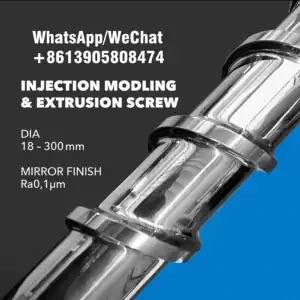
In the plastic processing industry, extruder screws are the driving force behind the melting, mixing, and conveying of raw materials. Whether you’re working with film blowing, pipe extrusion, pelletizing, or compounding, understanding the different extruder screw parts is essential to ensure consistent production, reduce downtime, and extend equipment life.
🔍 What Are Extruder Screw Parts?
An extruder screw is not a simple rod—it’s a precision-engineered part composed of multiple functional zones and components. These parts work together to transform raw plastic pellets into a homogeneous melt, ready for shaping.
🧩 Main Parts of an Extruder Screw
- Feed Section
- Purpose: Receives and starts conveying plastic pellets.
- Design: Deep flights to hold a large volume of solids.
- Common Issues: Abrasion from fillers, especially in recycled materials.
- Compression (Transition) Section
- Purpose: Builds up pressure and initiates plastic melting.
- Design: Flights gradually become shallower.
- Importance: Helps ensure even melting and pressure stabilization.
- Metering Section
- Purpose: Delivers a consistent and uniform melt.
- Design: Constant flight depth for stable output.
- Typical Use: Critical for precision applications like film or tubing.
- Mixing Section (Optional)
- Purpose: Disperses pigments, additives, or fillers.
- Types: Maddock mixers, blister rings, and spiral mixers.
- Ideal for: Masterbatch, color compounds, flame retardants.
- Degassing/Venting Section
- Purpose: Removes moisture or trapped gases.
- Design: Open barrel ports, often under vacuum.
- Use: Important for PET, PLA, or recycled polymers.
- Discharge Section
- Purpose: Delivers the final melt to the die head.
- Design: May include pressure-building features or check valves.
🔧 Structural Components of Extruder Screws
Beyond the functional zones, extruder screw assemblies may include:
| Component | Function |
|---|---|
| Screw Shaft | Central rotating axis that transmits torque. |
| Screw Tip | Located at the end; controls backflow (esp. in injection molding). |
| Kneading Elements | Used in twin screw extruders to shear and mix materials. |
| Threaded Elements | Modular screw design for easy configuration changes. |
| Keyways | Ensure secure coupling between screw and drive system. |
⚙️ Materials Used in Extruder Screw Parts
Material choice impacts durability, corrosion resistance, and overall service life. Common materials include:
- 38CrMoAlA (nitrided steel): Standard wear resistance
- SKD61 / H13: High thermal shock and fatigue resistance
- W6Mo5Cr4V2: Suitable for high-speed, high-wear conditions
- Bimetallic layers: Such as Colmonoy or PTA for enhanced wear/corrosion resistance
📌 Tip: For abrasive applications like CaCO₃ or glass fiber, always choose bimetallic or wear-resistant screw surfaces.
🏭 Applications of Extruder Screw Parts
These parts are crucial across various industries:
- Plastic pipe and profile extrusion
- Masterbatch and color compounding
- Recycled pelletizing (LDPE, HDPE, PP, PET)
- Biodegradable materials (PLA, PBAT)
- Wood plastic composites (WPC)
✅ Why Choose a Trusted Supplier for Extruder Screw Parts?
Poorly made screw parts lead to:
- Inconsistent product quality
- Premature machine wear
- Increased downtime and maintenance cost
That’s why it’s vital to work with an experienced manufacturer that provides precision machining, quality materials, and custom design services.
🔍 Recommended Supplier: Zhoushan Juyuan Machinery Co., Ltd.
With over 15 years of experience, Zhoushan Juyuan Machinery Co., Ltd. provides high-quality extruder screw parts, including:
- Single screw and twin screw elements
- Bimetallic barrels and liner segments
- Custom screw geometry for specific applications
- Fast lead time and global shipping
🌐 Website: https://juyuan-machinery.com
📧 Email: cxj.job@gmail.com
📱 WhatsApp: +86 13905808474