
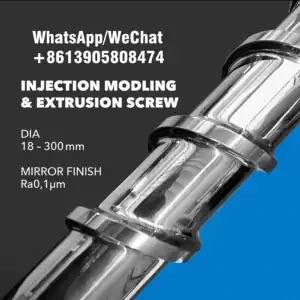
The extruder screw is the heart of any plastic extrusion or compounding system. It plays a vital role in melting, mixing, and conveying plastic materials through the barrel toward the die. Understanding the different parts of the extruder screw is essential for engineers, maintenance teams, and procurement specialists who want to optimize performance and longevity.
In this article, we break down the main sections and elements of extruder screws — focusing on both single-screw and twin-screw systems used in plastic extrusion and compounding.
🔩 Main Parts of an Extruder Screw
Whether you’re using a single-screw extruder or a twin-screw extruder, the basic structure of a screw consists of several key zones, each designed for specific processing tasks:
1. Feed Section
- Function: Transports solid plastic pellets or powder from the hopper into the screw.
- Design Features: Deep channels to carry as much solid material as possible.
- Wear Issue: Subject to high abrasion from fillers and glass fiber.
2. Compression Section (Transition Zone)
- Function: Compresses and melts the plastic by reducing channel depth.
- Design Features: Gradually decreasing flight depth for pressure and friction buildup.
- Importance: Ensures homogeneous melting and removal of trapped air.
3. Metering Section
- Function: Delivers fully melted plastic at a stable flow and pressure.
- Design Features: Constant channel depth for uniform melt.
- Use Case: Crucial for applications requiring high precision (e.g., film, fiber).
4. Mixing Elements (Optional)
- Function: Improves the dispersion and distribution of pigments or fillers.
- Types: Maddock mixers, spiral mixers, blister rings.
- Found in: Both single and twin-screw extruders depending on application.
5. Degassing/Venting Section
- Function: Allows trapped air or volatile gases to escape.
- Design: Often located after compression, with open barrel ports.
- Use: Common in recycled plastics or moisture-sensitive polymers like PET.
6. Discharge Section
- Function: Pushes the molten plastic into the die head.
- Design: Short zone, sometimes with pressure-building features.
🧩 Additional Components of Extruder Screw Systems
Besides the screw flights and zones, the full screw system may include:
- Screw Shaft: The central rotating axis supporting all screw elements.
- Screw Tip / Non-return Valve: Used in injection molding extruders.
- Kneading Blocks (Twin Screw): For intensive shearing and mixing.
- Screw Elements (Modular Screws): Interchangeable parts for custom configurations.
- Keyways and Coupling Ends: For torque transmission and connection to the gearbox.
🔧 Materials and Coatings
To handle tough materials like glass-filled plastics or corrosive PVC, screws are manufactured with:
- 38CrMoAlA / SACM645 (nitrided steel) for standard wear resistance
- W6Mo5Cr4V2 or SKD61 for higher strength
- Bimetallic coatings like Colmonoy or PTA welding for improved abrasion and corrosion resistance
🛠️ Pro Tip: Choosing the right screw material can extend lifespan by up to 3x in high-wear applications.
📈 Optimizing Screw Design for Performance
Customizing the screw geometry, compression ratio, and element layout (especially in twin-screw extruders) can significantly improve:
- Output rate
- Melting efficiency
- Mixing quality
- Energy consumption
- Material compatibility
📌 Final Thoughts
Understanding the parts of an extruder screw helps you make better decisions on maintenance, replacement, and machine design. Whether you’re producing masterbatch, recycled pellets, or engineering plastics, a well-designed screw ensures consistent quality and high productivity.
👨🏭 About Us
At Zhoushan Juyuan Machinery Co., Ltd., we specialize in manufacturing high-quality screw barrels and spare parts for extruders and injection molding machines. Our solutions are compatible with global brands and tailored to your processing needs.
📧 Email: cxj.job@gmail.com
📱 WhatsApp: +86 13905808474
🌐 Website: https://juyuan-machinery.com