
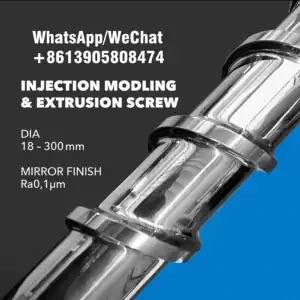
In modern plastic manufacturing, injection moulding screw barrel design plays a critical role in determining melt quality, cycle time, and overall production efficiency. A well-designed screw and barrel assembly ensures optimal plasticizing, stable pressure, and consistent output — all vital for producing high-quality molded parts.
1. Understanding Injection Moulding Screw Barrel Design
The screw and barrel together perform three essential functions: feeding, melting, and homogenizing the polymer before injection. The screw’s geometry — its diameter, pitch, compression ratio, and flight depth — is tailored to the characteristics of the processed material (PP, PE, ABS, PC, PVC, etc.).
A typical injection moulding screw is divided into three main zones:
- Feed Zone: Conveys and preheats solid granules.
- Compression Zone: Gradually melts and compresses the material.
- Metering Zone: Ensures a uniform, well-mixed melt ready for injection.
Each zone must be precisely designed to match the polymer’s melting behavior and the moulding machine’s output requirements.
2. Factors Affecting Screw Barrel Design
Several design parameters influence the performance of injection moulding screws and barrels:
- Screw Diameter & L/D Ratio: Larger diameters and longer screws (typically 18:1 to 24:1) offer better mixing and melting.
- Compression Ratio: Usually between 2:1 and 3:1 for most thermoplastics; higher ratios are used for crystalline materials.
- Flight Design: Variable pitch or barrier screws improve mixing and prevent unmelted particles.
- Material Selection: Nitrided or bimetallic barrels, along with wear-resistant screw coatings, enhance durability for glass-filled or recycled materials.
- Venting & Mixing Sections: Optional features like mixing heads or venting zones enhance colour dispersion and melt uniformity.
A properly designed injection moulding screw barrel reduces cycle time, improves melt consistency, and lowers energy consumption.
3. Customized Design for Different Materials
Each polymer requires a unique design approach. For example:
- PVC: Needs a low-shear screw with deeper flights to prevent burning.
- PC & PMMA: Require precise temperature control and a balanced compression ratio to avoid degradation.
- Recycled HDPE or PP: Benefit from bimetallic barrels and hardened screw surfaces to resist abrasion.
At Zhoushan Juyuan Machinery Co., Ltd., we specialize in customized Injection Molding Screw and Barrel solutions, designed according to your machine model, processing material, and output target.
4. Benefits of Optimized Screw Barrel Design
An optimized screw and barrel combination offers several advantages:
- Uniform plasticizing and stable melt pressure
- Shorter cycle time and lower energy use
- Enhanced part quality and dimensional stability
- Extended service life with wear-resistant materials
- Reduced maintenance and downtime
These benefits directly translate to higher productivity and lower operational costs.
5. Choosing the Right Partner
Whether you’re upgrading an existing injection moulding line or developing a new machine, the right screw barrel design can make a significant difference. Our engineers provide detailed technical evaluation, 3D design drawings, and alloy selection guidance to help you achieve the best results.
Explore our full product range:
Contact Us Today
For customized injection moulding screw barrel design or technical consultation, please reach out to us:
📧 Email: cxj.job@gmail.com
📞 WhatsApp/WeChat: +86 13905808474
🌐 Website: https://juyuan-machinery.com